

Instagram Isn't Your High School
And Twitter was never your town square

During the season finale of TikTok (part 1), when American users of the app began to realize that the app would actually be shutting down, a peculiar thing happened. Users started anticipating what would come after TikTok: would it be lemon8, the ByteDance-owned app that’s been pushed on TikTok users, or RedNote, the Chinese short-form video app that TikTokers started migrating to? People started downloading their TikTok archives and joking about the anticipated migration to another platform, even going so far as to call themselves “TikTok Refugees.” I wasn’t surprised by some of these things - at 28, I’ve lived through the birth and death of Vine, the exodus from Tumblr, and the slower trickle out of Twitter as Elon Musk has slowly starved the app of life. It feels natural to me that digital communities are built and eventually die, and as these platforms become entwined with our livelihoods, it also feels natural that people were stressed and confused. What didn’t feel natural, though, was the way people characterized TikTok as they mourned it — the deep relationships they had with the app, and more importantly, how they ascribed a national identity to TikTok, branding themselves as refugees. We talk about parasocial relationships with content creators, but what about the relationships we have with the platforms themselves?
As TikTok was on its way out, people expressed genuine anxiety at the thought of bringing their “TikTok selves” to Instagram, which several TikTok creators described as feeling like high school. Now this is where my eyes really started to narrow. The central basis of the statement is true — each social platform has its own architecture and by extension, its own culture. TikTok defaults to a feed that shows you posts from people you don’t know, which might feel like freshman year of college compared to Instagram’s non-chronological feed of the same people you’ve been following since you likely made the accounts (which, for me, was actually high school!). But Instagram isn’t actually like my high school, which served as a context for the deep relationships and education that have brought me where I am today. My argument isn’t so much that these social platforms aren’t important spaces that should be architected with care, but rather that these platforms benefit greatly from us thinking that they are democratic, egalitarian spaces, or even that they are analogous to the real-life communities we exist in. When we make these platforms out to be more than what they are, it’s easy to forget that what’s really being bought and sold on the internet is our data and our attention. Part of the reason these platforms will never be like my high school is because my high school couldn’t monetize my attention or keep me at school all day to receive more funding.
Tech companies have always been interested in being embedded in our lives — they don’t want us to see their products as tools, but rather as a part of ourselves. This is most conveniently exemplified by the iconic Apple ad — I think, therefore iMac. The ad is a cheeky play on Descartes's famous quote, I think therefore I am, a phrase that represents the only irrefutable truth that Descartes could come to after examining his very existence. When we take a look at the iMac ad in that context, the goal is for you to see the computer as an extension of yourself. The ad was also a play on IBM’s “I think, therefore IBM” ads of the late 80s, making the idea of the computer-as-self an industry tagline. The intent is clear — to position the computer not as a tool to allow you to accomplish your goals, but as an extension of yourself, or a member of the family.
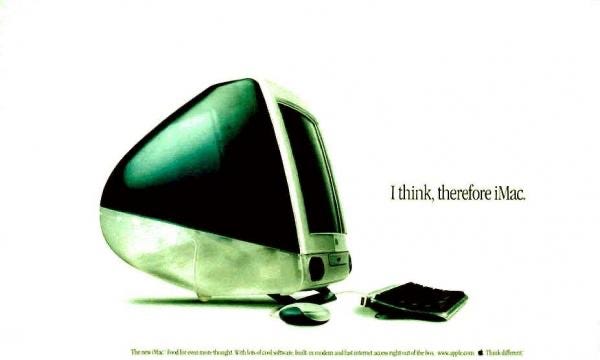
Similarly, the tech platforms of today want to ensure that you don’t just see them as tools or places to visit — they benefit financially from your attention and will do anything to make sure that all of your creative output, emotional stimulation, and economic opportunity are tied to their platforms because ultimately that keeps you on their platforms. The Uber Eats Super Bowl ad comes to mind here - football was invented just to sell you food, and Twitter was invented to keep your eyes glued to your phone, and conveniently, to thousands of advertisements a day. Twitter can’t be your town square for many reasons, the least of which being that your town square isn’t financially invested in stripping you of your attention. Moreover, a true town square isn’t a space where you can say anything you want uncontested, but rather a place where people who are directly affected by a community, who are invested in the wellbeing of their community and each other, gather to govern themselves. It’s pretty boring and bureaucratic and there isn’t a 140-character limit. Most importantly, though, there’s no algorithm and no going viral in a town square. Reddit is a lot closer to your town square than Twitter ever was. Real revolution has been propelled by images shared by activists on Twitter, but that certainly isn’t the intention of the founders. We have enough data now to see the positive benefits of social media as aberrations, not the norm.
These platforms benefit greatly from you believing they are public utilities, but will never regulate themselves like utilities or welcome the kind of regulation that actual public utilities get. The problem is compounded by the fact that when we’re upset about these social networks’ faults, we often use the very platforms we’re critiquing while decrying them. Our tech oligarchs are not interested in solving problems or innovating, they’re merchants of our attention, hoping desperately that we will bond so closely with their platforms that we’re unwilling to let them go. They benefit greatly from us being in relationship with their platforms, anthropomorphizing them as our high school cafeterias and college libraries. That allows the more difficult truth, the fact that these platforms are slickly-wrapped attention vacuums, to remain hidden under layers of goodwill and dependence on the very platforms that are making us burnt out and lonely. And what do the men who buy and sell our data and attention do with the money they make? They hoard material resources. While Mark Zuckerberg is selling you immaterial fantasies (virtual connection) that zap intangible human resources from you (attention, time), he’s also slowly buying up 5,000 acres of land in Hawaii and creating a bunker to hide out in once climate change comes for us all.
The fact of the matter is that we live in a world where participation in the internet isn’t always optional. Like it or not, these platforms are intimately tied to a lot of our work and play, but let’s not be blinded by the immaterial fantasies that keep us tied to these platforms. They’re tools for us to use to our benefit, not saviors of humanity. Instagram is not your high school, and if it gives you anxiety to post or engage — free yourself! Delete it! Twitter was never your town square, but I’m sure your neighborhood *does* have a local council where you can give your opinions amongst a community that has similar material needs and goals as you. Substack is not the liberal arts college you never attended, but self-study is at your fingertips at your local library, and you might meet some friends there too. I just don’t believe we should entrust the very best of us — our intellect and our affect, to platforms built by the front row of the Trump inauguration.
Absolutely stellar.